

Share this article

Table of Contents

AI Readiness Assessment: Is Your Business Ready to Implement AI?

AI Readiness Assessment: Is Your Business Ready to Implement AI?

Table of Contents

Key Takeaways

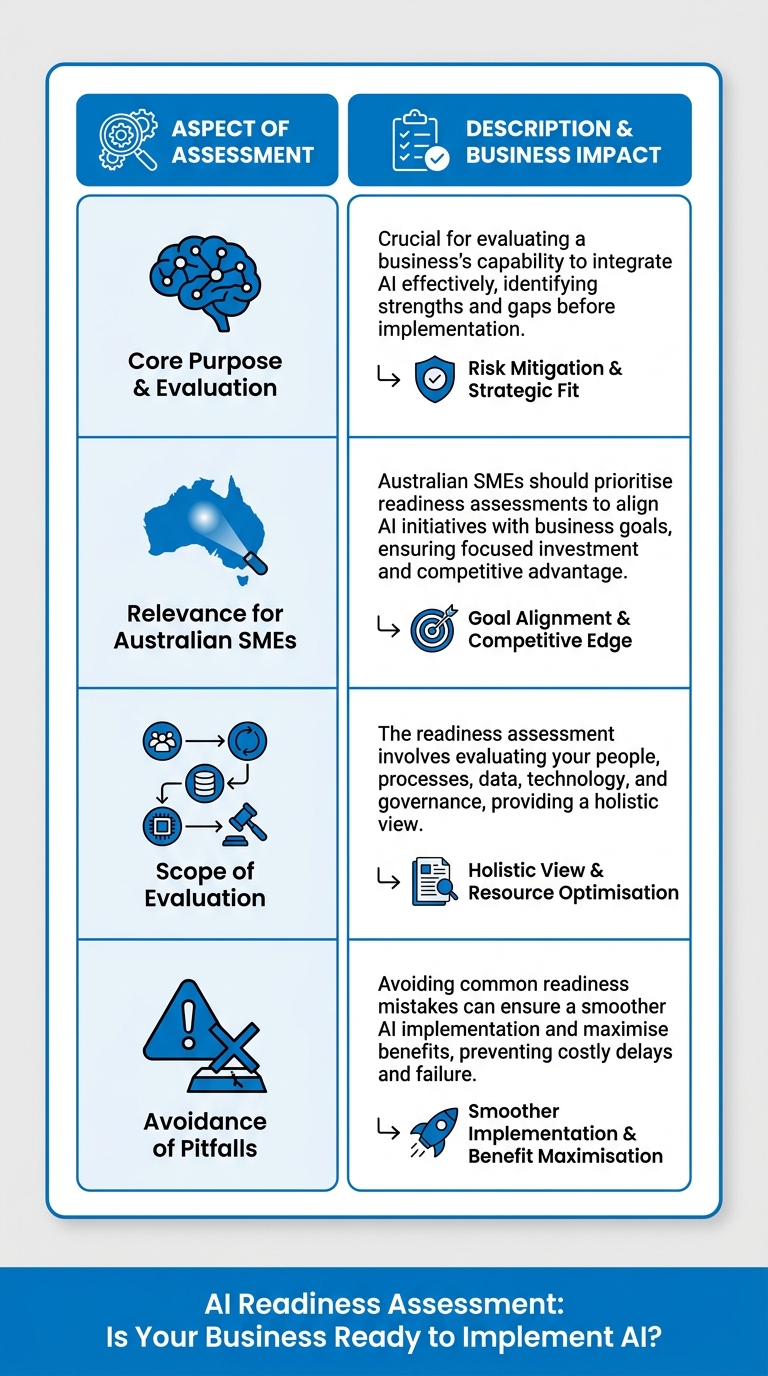
  • An AI Readiness Assessment is crucial for evaluating a business’s capability to integrate AI effectively.

  • Australian SMEs should prioritise readiness assessments to align AI initiatives with business goals.

  • The readiness assessment involves evaluating your people, processes, data, technology, and governance.

  • Avoiding common readiness mistakes can ensure a smoother AI implementation and maximise benefits.

Key Answer

An AI Readiness Assessment evaluates a business’s preparedness for AI implementation, focusing on people, processes, data, and technology. It’s essential for identifying gaps and ensuring a smooth transition to AI-driven operations.

Are you pondering whether your business is ready to dive into the world of Artificial Intelligence (AI)? An AI Readiness Assessment is your starting point.

This essential step ensures your venture is prepared to take on AI technologies, which promise to optimise operations and drive innovation. But before you invest, understanding your current capabilities is key.

What Is an AI Readiness Assessment?

An AI Readiness Assessment is a comprehensive evaluation of your organisation’s capability to integrate AI technologies effectively. It examines core aspects like your people, processes, data, and technology infrastructure. The goal? To pinpoint gaps that could hinder successful AI adoption and outline a clear path towards becoming AI-ready.

This assessment is not merely a checklist; it’s a strategic framework tailored to your business’s unique needs. For Australian SMEs, this means taking into account local market dynamics and regulations, such as Australia’s Privacy Act, which governs how you manage data privacy. By conducting an AI Readiness Assessment, you gain insights that help align AI initiatives with your strategic objectives, ensuring that investments in AI yield tangible returns.
infographic_abyKRBn1yO.jpg

Why Australian SMEs Should Assess AI Readiness First

Before jumping into AI, assessing readiness is crucial, especially for Australian SMEs operating in a competitive environment. This assessment helps in identifying key areas where AI can have the most impact, such as customer support, inventory management, or data analysis. It also helps in understanding the potential challenges you might face, like data privacy issues or the need for upskilling your workforce.

AI technologies can transform your business operations, but without a readiness assessment, you risk facing implementation hurdles. It’s about preparing your business to not just integrate AI but to do so effectively, maximising benefits and minimising risks. This proactive step is a safeguard against the costly mistakes of improper AI integration, which can lead to wasted investments and operational disruptions.

Signs Your Business Is Ready for AI

How do you know if your business is ready to implement AI? Look for these key indicators:

Data Availability: You have access to quality data that is clean, relevant, and well-organised.

Technological Infrastructure: Your IT infrastructure can support AI technologies, with scalable systems and robust data storage solutions.

Employee Preparedness: Your team is open to change and upskilling, crucial for successful AI integration.

Strategic Alignment: AI initiatives align with your business goals, ensuring they support rather than disrupt your operations.

If your business ticks these boxes, you’re likely ready to embrace AI. However, a thorough readiness assessment can confirm this and highlight areas that need improvement.

The Five Pillars of a Business AI Assessment

A comprehensive AI readiness assessment for SMEs typically revolves around five key pillars:

People: Assess the skills and openness of your team to work alongside AI.

Processes: Analyse existing workflows to identify which can be enhanced by AI.

Data: Evaluate the quality and availability of your data for AI applications.

Technology: Examine your current IT infrastructure to ensure it can support AI initiatives.

Governance: Ensure compliance with regulations like Australia’s Privacy Act, setting rules for data usage and AI deployment.

These pillars form the foundation of a strong AI strategy, helping to ensure that your business is not only ready for AI but can also leverage it effectively.

AI Implementation Checklist for SMEs

Here’s a step-by-step AI implementation checklist tailored for Australian SMEs:

Conduct an AI Readiness Assessment: Identify gaps in readiness and areas for improvement.

Build a Data Strategy: Ensure you have the data quality and infrastructure needed for AI.

Choose the Right AI Tools: Select tools that align with your business goals and technical capabilities.

Upskill Your Workforce: Train employees to work with AI, focusing on collaboration rather than replacement.

Pilot AI Projects: Start with a small-scale project to test the waters and refine your approach.

Monitor and Optimise: Regularly review AI performance and make adjustments as needed.

By following this checklist, you can ensure a structured and successful AI implementation, minimising risks and maximising benefits for your business.

Common AI Readiness Mistakes to Avoid

Avoid these common pitfalls to ensure a smooth AI integration:

Skipping the Readiness Assessment: This is crucial for identifying gaps and avoiding costly mistakes.

Ignoring Employee Concerns: Address ‘AI anxiety’ by involving staff in the planning process and providing training opportunities.

Underestimating Data Needs: Insufficient or poor-quality data can undermine AI projects.

Overlooking Governance: Compliance with regulations is non-negotiable, especially concerning data privacy.

By steering clear of these mistakes, you’ll create a stronger foundation for AI in your business, fostering a positive and effective AI journey.

What Happens After an AI Readiness Assessment?

Once your AI readiness assessment is complete, you have a roadmap to follow. This involves addressing identified gaps, refining strategies, and initiating AI projects that align with your business objectives. It’s about continuous improvement and optimisation, leveraging AI to drive efficiency and innovation.

Implementing AI is not a one-off task; it requires ongoing effort.

Regularly update your AI systems to adapt to new data and technologies, and ensure your team stays informed about the latest AI trends and tools. This proactive approach will help maintain your competitive edge.

How an AI Strategy Consultant Can Help Your Business Succeed

Engaging an AI strategy consultant can significantly ease your AI journey. They bring expertise in identifying AI opportunities tailored to your industry, selecting appropriate tools, and guiding you through the implementation process. Consultants also help manage change within your organisation, addressing employee concerns and ensuring a smooth transition.

By partnering with a consultant, you gain access to proven strategies and insights that enhance your AI projects’ success rate. This collaboration can be especially beneficial for Australian SMEs, providing the expertise needed to navigate the local business landscape effectively. Consider booking a consultation today to receive a tailored AI readiness assessment and roadmap to implementation success.

Schedule your consultation now!

Frequently Asked Questions

An AI Readiness Assessment helps identify your business’s strengths and gaps in AI adoption, ensuring efficient and successful implementation.

The key pillars include People, Processes, Data, Technology, and Governance. Each is crucial for evaluating AI readiness and planning effective implementation.

Common mistakes include skipping readiness assessments, ignoring employee concerns, underestimating data needs, and overlooking governance issues.

An AI Strategy Consultant provides expertise, identifies tailored AI opportunities, and guides you through the implementation process, ensuring a smooth transition.

After an assessment, address identified gaps, refine strategies, and initiate AI projects aligned with your business goals for continuous improvement and optimisation.

Scroll to Top